




The best cycling tours in Spain: 12 experiences worth living
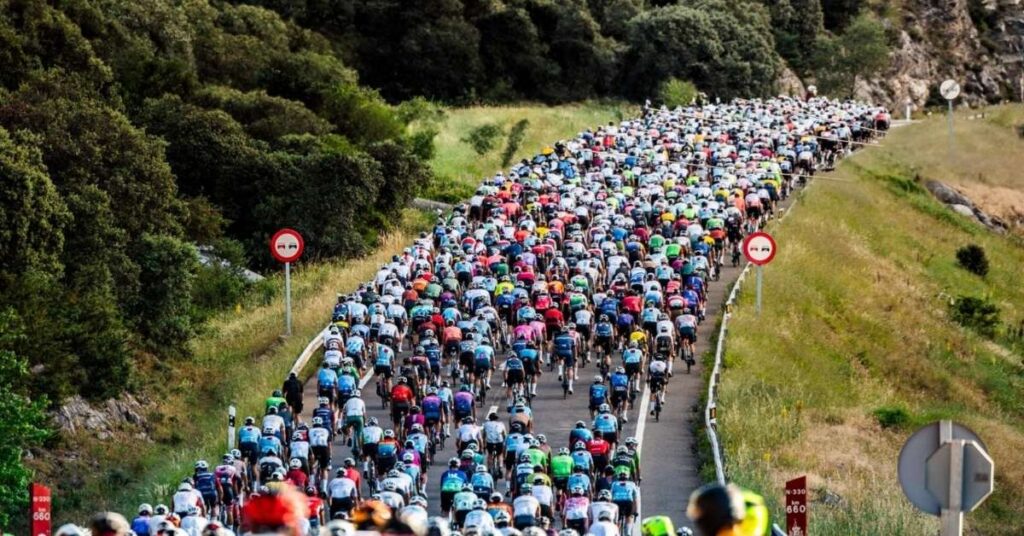
Quebrantahuesos, Mallorca 312, Irati Xtrem, Lagos de Covadonga, La Remences, and Bilbao-Bilbao represent very different approaches to cycle tourism. These are joined by more recent events like the Vuelta Ciclista a Lanzarote and the Gran Fondo Jaén, which offer distinct experiences without competing to be the toughest ride.
Spain boasts a very extensive road cycling calendar. There are routes of over 300 kilometers, gran fondos in the high mountains, historical races, unclassified rides, and events where cycling is also used as a way to discover a region.
Therefore, talking about the best cyclotourism events in Spain should not be reduced to ordering the events by kilometers, elevation gain or number of participants.
This selection is not a ranking from 1 to 12. We have looked for rides that offer something different in terms of history, route, atmosphere, format or experience, taking into account both the information from their organizers and the feelings that are repeated among cyclists who have participated in them.

If you're looking for specific dates to prepare for the next season, you can also check our calendar of cycling events in Spain , updated as organizers confirm new editions.
12 routes, 12 different ways to experience cycle touring
| Walking | Why it stands out | Profile |
|---|---|---|
| Bearded Vulture | The great classic of the Pyrenees | Long distance and high mountain |
| Mallorca 312 | The challenge of distance | Long and ultra-distance |
| Irati Xtrem | Cycle touring without obsession with rankings | Mountain and experience |
| Covadonga Lakes Challenge | A historic summit finish | Climbers |
| The Remences | One of the great Catalan classics | Balanced fund |
| Montsec-Montsec | Mountain and less crowded | Experienced cyclists |
| Bilbao-Bilbao | Tradition and non-competitive philosophy | Introduction and cycle touring |
| Lanzarote Cycling Tour | Two stages, regroupings and tourism | Ideal for discovering this format |
| Mussara Salou Costa Daurada | Great event and atmosphere of the Pink Tide | Large modern background |
| 3 Nations | Three countries in one day | High mountain |
| Gran Fondo Jaén Paraíso Interior | Roads and Olive Grove Paths | Someone looking for something different |
| The Indurain | Three distances and roads in Navarre | different levels |
Bearded Vulture: the great classic of the Pyrenees
The Quebrantahuesos , starting and finishing in Sabiñánigo, is probably one of the first names that comes to mind when talking about major Spanish cycling events.
Its Gran Fondo maintains a route of 200 kilometers and around 3.500 meters of positive elevation gain, crossing four mountain passes that have built a good part of the identity of the event: Somport, Marie Blanque, Portalet and Hoz de Jaca.
The demand for race bibs is also a sign of its scale. Participation is limited, and the organizers use a lottery system when applications exceed the available places. There's also the Treparriscos, an 85-kilometer race, for those looking for a much shorter distance.
Its large size also means riding for much of the day surrounded by numerous cyclists. Among regular participants, there's also a significant competitive element, and it's not uncommon to find groups tackling the ride aiming to improve their times.
To complete it successfully, you need experience accumulating hours on the bike, mountain training, and a good nutrition and pace strategy.
Mallorca 312: when the challenge is the kilometers
The Mallorca 312 represents another dimension of the gran fondo: distance.
The event currently offers three options of 312, 226 and 167 kilometers , allowing for considerable customization of the challenge.
The 312-kilometer course transforms the day into an endurance test that goes far beyond simply climbing well. Managing effort over so many hours, eating from the start, and avoiding an excessive pace in the first few kilometers are almost as important as physical fitness itself.
Its international dimension is also part of the experience. During those days, Mallorca becomes a major meeting point for amateur cyclists from different countries.
Precisely because of its size, the experience is different from that of a small march: the large starting groups, the management of the pace and the aid stations take on considerable importance during the day.
Irati Xtrem: cycle touring before competition
The Irati Xtrem probably offers one of the greatest contrasts with the big fondos where the final time takes center stage.
The organizers themselves define the event as non-competitive : there is no overall ranking or winners. After the first few kilometers are neutralized, each participant continues at their own pace.
Anyone wanting to test themselves against the clock has one specific option: the Larrau time trial , where timekeeping is voluntary.
This approach significantly changes how the route is experienced. In conversations among cyclists who have participated in various races, Irati frequently comes up as an example of a race where there is more space to share kilometers, stop at aid stations, and enjoy the surroundings without the entire day revolving around a ranking.
That doesn't mean it's easy. The Navarrese Pyrenees and the surroundings of the Irati Forest offer enough terrain to make it a significant challenge even without looking at the stopwatch.
For those looking for a challenging ride but wanting a more relaxed approach to cycle touring, this is one of the most interesting options in this selection.
Covadonga Lakes Challenge: conquering a summit with history
The Lagos de Covadonga Challenge has something that many marches cannot produce: a final destination immediately recognizable to any cycling fan.
The Gran Fondo category covers 111 kilometers , starting in Cangas de Onís and finishing at the Lakes of Covadonga.
Before the final climb, other difficulties appear, but the ascent towards Lagos inevitably takes center stage.
The ramps of La Huesera, the Mirador de la Reina and the arrival at the lakes give the end of the walk an identity that is difficult to replicate.
There is also a 99-kilometer Medio Fondo route that ends in Covadonga without tackling the final climb to the Lakes.
It is especially recommended for those who need a very specific goal during their preparation: to arrive in Covadonga with enough strength and then face one of the most recognizable climbs in Spanish cycling.
La Remences: one of the great Catalan classics
La Remences · Energy Tools , known for years by many cyclists as Terra de Remences, remains one of the most traditional marches in Catalonia.
The long route is 175 kilometers long with approximately 2.600 meters of elevation gain , while the short option is 100 kilometers long with 1.280 meters of elevation gain.
The Garrotxa region and the succession of mountain passes allow for a demanding route without needing to reach the extreme duration of Mallorca 312.
It is a particularly interesting option for those looking for a classic mountain bike ride: enough distance and elevation gain to require serious preparation, but without yet entering the ultra-distance category.
Montsec-Montsec: one of the least obvious choices in this selection
The Montsec-Montsec , starting in Balaguer, has less recognition among the general public than Quebrantahuesos or Mallorca 312, but maintains a very marked identity within Catalan cycle tourism.
In 2026, it offered three routes of 80, 140, and 190 kilometers . Its Gran Fondo reached approximately 3.300 meters of positive elevation gain.
We are therefore looking at a course serious enough to demand extensive preparation, but within a more contained event. The organizers limited the 2026 edition to 1.000 participants.
In conversations among experienced cycle tourists, it is precisely this combination of route, scenery, and smaller size of the event that usually appears among its main attractions.
It is one of the less obvious inclusions in this guide, but also one that best demonstrates that not all great cycle touring experiences are the most well known.
Bilbao-Bilbao: unclassified cycle tour
The Bilbao-Bilbao race demonstrates that an important march does not necessarily need an extreme distance or a competitive ranking.
Held since 1988, it maintains a non-competitive format and offers three routes of 85, 115 and 125 kilometers.
This makes it especially interesting for those who want to make their debut in a major cycling event without having to face 170 or 200 kilometers of high mountain terrain from the start.
This doesn't mean the Basque terrain is easy. The constant changes in gradient eventually accumulate, especially on the longer route.
But their philosophy is different: completing the march and sharing the experience are more important than occupying a position in a ranking.
Tour of Lanzarote: a different gateway
The Vuelta Ciclista a Lanzarote is one of the most recent additions to this selection and its youth has allowed it to propose a different format.
The 2026 edition, the third of the event, proposed 189 kilometers spread over two days of 115 and 74 kilometers, covering the seven municipalities of Lanzarote.
Its main difference lies in the way the peloton is organized. The organizers themselves define the event as non-competitive, and a large part of the route consists of regroupings that allow cyclists of different skill levels to come together again.
The competitive element is concentrated in certain time trials. Those who want to push themselves can do so there; afterwards, the route regains its collective character.
This makes the Vuelta a particularly interesting option for those new to this type of experience . Two stages and 189 kilometers still require preparation, but participants don't have to turn every kilometer into a struggle to keep up with a wheel.
Furthermore, the route is built around the island itself. Famara, La Geria, Timanfaya, the volcanic roads, the inland villages, and the coastal areas make the island a central part of the attraction.
In our chronicle of the 2026 Tour of Lanzarote, we analyzed precisely this way of understanding cycle tourism, where competing is a possibility and not an obligation.
Mussara Salou Costa Daurada: the Pink Tide
The Mussara Salou Costa Daurada represents a different way of turning a cycle tour into a great sporting event.
Its well-known Pink Tide , the start from Salou and all the activity surrounding the event are part of the experience along with the route itself.
The routes may change between editions. In 2026, the long distance was 183 kilometers with 2.850 meters of elevation gain , while the short distance was 106 kilometers.
The organization itself defines Mussara Salou as a non-competitive cycling tour, although its size and the presence of thousands of participants create a very different experience from smaller events.
That's probably the best way to understand it: Mussara isn't trying to offer the same thing as Irati Xtrem or Bilbao-Bilbao. Its appeal lies precisely in the atmosphere of a major event that it has built around cycling.
3 Nations: Spain, Andorra and France within 140 kilometers
The Marxa 3 Nacions has a challenge that is hard to match: completing the same march through Spain, Andorra and France.
Starting from Puigcerdà, its current route covers 140 kilometers and approximately 2.100 meters of positive elevation gain , passing through places like the Port d'Envalira and the Coll de Puymorens.
The altitude and long climbs mean the distance shouldn't be misleading. It doesn't reach the 200 kilometers of other gran fondos, but it packs a good dose of high mountain terrain.
It's a good option for those looking for Pyrenean scenery and great mountain passes, but who don't yet want to face the duration of a Quebrantahuesos race.
And it also has that geographical component that hardly any other Spanish march can offer: crossing three countries by cycling in a single day.
Gran Fondo Jaén Paraíso Interior: cycling along the Olive Groves
The Gran Fondo Jaén Paraíso Interior has earned a place in this selection by doing something clearly different.
Its route combines paved road with the so-called Olive Grove Paths , dirt sections that convey to the cyclist part of the identity of the professional Jaén Classic.
The 2026 edition covered 116,2 kilometers and featured five Olive Grove sections. For 2027, the organizers have already published a route with six unpaved sections , confirming that gravel will continue to be the defining characteristic of the event.
This brings into play factors that are less common in a conventional gran fondo: tire choice and pressure, technique on dirt, and greater attention to possible punctures or breakdowns.
It doesn't need to be the longest route in this selection to offer a different challenge. For those who have already participated in several traditional long-distance rides and want a change of scenery, the paths through olive groves provide a clear reason to travel to Jaén.
The Indurain: three distances to choose the challenge
The Indurain route starts in Villava and travels along Navarrese roads closely linked to the figure of Miguel Indurain.
One of its strengths is its variety: it offers routes of approximately 65, 100 and 180 kilometers.
The long route reaches 3.252 meters of elevation gain , making it a true mountain climb. The shorter options, however, allow you to enjoy the same event with a significantly lower level of challenge.
This ability to choose makes it especially interesting for groups of cyclists with different levels who want to share the same weekend and take on different challenges.
So, what is the best cycling tour in Spain?
That question probably doesn't have a single answer.
If you're looking for a true classic and want to tackle 200 kilometers of the Pyrenees, the Quebrantahuesos remains the benchmark. If you want to discover the limits of your endurance, the Mallorca 312 operates on a different scale.
For those who understand cycle touring as mountains, landscapes and shared kilometers without everything depending on a general classification, Irati Xtrem offers a particularly attractive philosophy.
If your goal is to conquer a recognizable summit, Lagos de Covadonga has few rivals. If you prefer to start with a well-established but non-competitive event, Bilbao-Bilbao offers a choice of three distances.
And for those who want to get started in an organized multi-day experience without everything revolving around competition, the Vuelta Ciclista a Lanzarote offers one of the most interesting formats in recent years.
Montsec-Montsec, La Remences and 3 Nacions allow you to explore the mountains from different perspectives, while Gran Fondo Jaén directly changes the terrain with its Olive Grove Trails.
The important thing is to understand what you are looking for before you sign up.
How to choose your first cycling tour
Don't choose based solely on the name or the number of kilometers. First, consider how much time you can train and what type of terrain is available during your preparation.
A cyclist accustomed to riding 100 kilometers on flat terrain may encounter significant difficulties on a shorter ride with 2.500 meters of elevation gain. Similarly, being a good climber doesn't guarantee readiness to spend ten or twelve hours on the bike.
It's also worth checking how each event works. There are timed rides, completely non-competitive events, timed sections, roads open to traffic, and events with different control and safety systems.
Nutrition deserves the same attention. After several hours of exertion, eating and drinking properly ceases to be a minor detail and becomes a fundamental part of the strategy.
If you are preparing for your first event of this type, you can also consult our tips for participating in a cycling tour.
The routes change: always check the edition you are going to compete in
The distances and elevation changes of a race can vary from one edition to another. So too can the schedules, roads used, cut-off times, regulations, licensing requirements, or timing format.
Therefore, this guide should be understood as a selection of experiences, not as a substitute for the official information of each edition.
Before registering or starting any specific training, always check the route and regulations published by the organizers for that year. The links included in this guide lead to the official websites for each event.
Spain has enough cycling routes to avoid reducing cycle to just the longest or toughest ride. Sometimes the main goal is to cross the Portalet pass, climb to the Lagos de Covadonga, or complete 312 kilometers. Other times it's touring Lanzarote for two days, cycling around Irati without a timed event, or arriving back in Bilbao with a group.
Ultimately, the best gear will be the one that best suits the way you want to enjoy cycling.
This content has been created with the support of AI tools and reviewed by the Triathlon News editorial team.
