




Does drafting improve cycling performance? Here's what science says
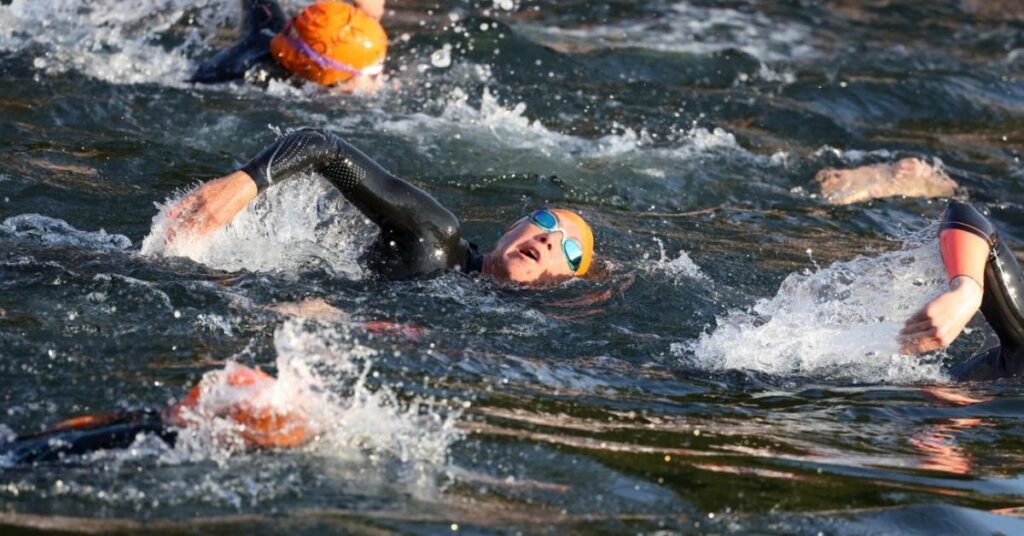
Drafting behind another triathlete can have benefits beyond the swim leg. A study of eight athletes found a 4,8% improvement in cycling efficiency after swimming behind another competitor. Other research suggests that managing effort effectively in the water can influence subsequent performance.
In triathlon, it's not just the swim time that matters . The effort expended to reach the first transition and how that can affect the remaining kilometers also counts.
Taking advantage of another swimmer's slipstream is a common strategy in competition, but to what extent can it help later on the bike?
A 4,8% improvement in cycling efficiency
In 2003, a team of researchers led by Anne Delextrat published a study in Medicine & Science in Sports & Exercise on the effects of drafting on subsequent cycling.

Eight well-trained male triathletes participated , completing two combined swimming and cycling sessions.
In both events they had to swim 750 meters at race pace in a wetsuit and then complete 15 minutes of cycling on a cycle ergometer, at 75% of their maximum aerobic power.
The difference was in the swimming: in one session they swam without drafting and in the other they followed another swimmer, maintaining the same speed.
The results showed that cycling efficiency was 4,8% higher after drafting compared to the condition without drafting, a statistically significant difference.
The researchers noted that some of that improvement could be explained by the relatively lower intensity of the effort exerted during swimming.
The 4,8% doesn't mean pedaling 4,8% faster. It's an efficiency improvement measured in a laboratory, not a gain in speed, power, or race time.
Another study found differences in power output on the bicycle
A study published in 2007 in the Journal of Science and Medicine in Sport analyzed a similar issue with nine trained triathletes.
The participants completed three 400-meter swimming tests followed by a 20-minute cycling time trial. The conditions were: swimming at maximum speed without drafting, swimming at 90% of that speed without drafting, or swimming in draft at a speed close to maximum.
Average power output during cycling varied depending on the pre-condition:
| Swimming condition | Average cyclist power |
|---|---|
| Maximum effort without drafting | 226 W |
| 90% of the speed, without drafting | 253 W |
| Drafting | 249 W |
Triathletes maintained significantly higher power output after swimming in a slipstream or at a lower speed than after swimming at maximum power without assistance.
However, there were no statistically significant differences between drafting and slowing down.
This result introduces an important nuance: the advantage doesn't depend solely on following another swimmer. Regulating the intensity of the first segment can also help you approach the cycling leg in better condition.
Why can drafting influence cycling?
When a triathlete swims behind another, they can take advantage of their slipstream to reduce drag and maintain a certain speed with less effort.
This energy saving can be relevant when starting the next segment, especially if it allows you to avoid excessive swimming intensity.
The relationship between the two sports has also been studied from another perspective. In 2005, research published in the British Journal of Sports Medicine analyzed how different swimming intensities affected subsequent triathlon performance.
Nine highly trained male triathletes performed sprint triathlon simulations by swimming at different intensities relative to their maximum reference speed.
The results showed improved cycling times when the swim was performed below that maximum intensity. Under one of the lower intensity conditions, the overall triathlon time also improved compared to the maximum swim intensity.
Taken together, these studies suggest that managing effort during swimming may be as important as trying to get out of the water a few seconds earlier.
How can an amateur triathlete benefit from it?
The practical application isn't about finding the right feet at any cost. The important thing is to find a rhythm that allows you to swim comfortably without constantly accelerating to maintain your position.
If the swimmer in front is going too fast, trying to keep up can end up increasing the effort instead of reducing it.
It is also important to maintain good orientation and not depend entirely on the trajectory of the athlete who sets the pace.
In our guide to open water swimming tips we explain the usual positions to take advantage of the slipstream and other useful technical aspects in competition.
Another issue is the use of the legs. Their function changes depending on the swimmer's level and the race circumstances, an aspect we address in our article on leg use during the triathlon swim.
To check how each athlete responds, it can be useful to practice combined swimming and cycling sessions with different intensities, paying attention to the sensations and subsequent performance.
What should we consider before drawing conclusions?
Although the results are interesting, all three studies have limitations . They were conducted with small samples of trained male triathletes under controlled conditions.
Furthermore, the drafting studies used swimming distances of 400 and 750 meters and cycling exercises of 15 or 20 minutes. Therefore, their results cannot be directly applied to an Olympic triathlon, an IRONMAN 70.3, or a long-distance race.
Nor do they allow us to ensure that all triathletes receive the same benefit.
What they do show is that the way you approach the swim can influence your subsequent performance. Making good use of the slipstream and avoiding unnecessary effort are two strategies worth considering, keeping in mind that the right pace depends on each athlete and the race conditions.
Scientific studies consulted
Delextrat et al. (2003). Drafting during swimming improves efficiency during subsequent cycling . Medicine & Science in Sports & Exercise.
The effects of exercise intensity or drafting during swimming on subsequent cycling performance in triathletes (2007). Journal of Science and Medicine in Sport.
Peeling et al. (2005). Effect of swimming intensity on subsequent cycling and overall triathlon performance . British Journal of Sports Medicine.
This content has been created with the support of AI tools and reviewed by the Triathlon News editorial team.
