




The Vuelta Ciclista a Lanzarote closes its third edition, showcasing another way to experience cycle tourism.
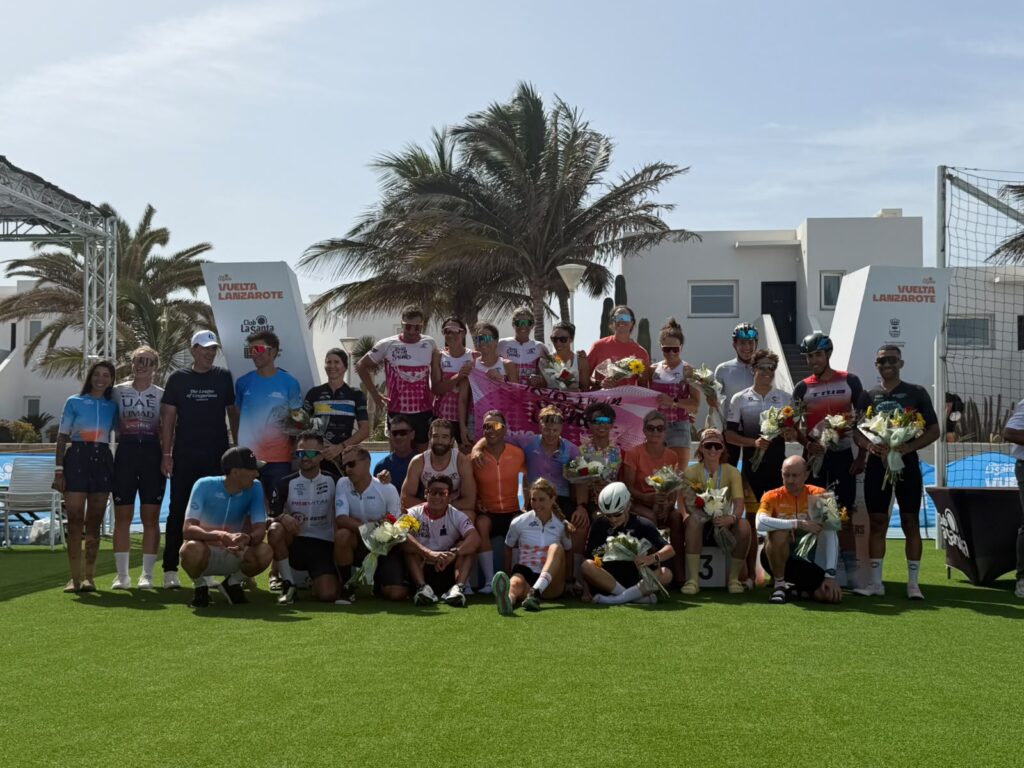
The 2026 Lanzarote Cycling Tour concluded its third edition this Sunday after two days and 189 kilometers that showcased a way of understanding cycle tourism in which the route, the regroupings, the atmosphere and the possibility of getting to know the island have as much weight as the effort on the bicycle itself.
More than 500 cyclists from 24 nationalities have participated in a ride that crosses the seven municipalities of Lanzarote and maintains a format clearly oriented towards the popular cyclist.
This is not your typical stage race. Much of the route is covered in a group, there are numerous regrouping and refreshment points, and the competitive element is concentrated in timed sections for those who want to push themselves a little harder.
This approach makes the Vuelta a particularly interesting option for those who want to get started in a cyclotourism event : it requires preparation to face two days on the bike, but allows you to do so without being concerned about a ranking throughout the entire route.

A bike ride to discover Lanzarote
One of the elements that most differentiates the Vuelta Ciclista a Lanzarote is that the route is not concentrated in a specific area of the island.
Throughout the weekend, participants travel through the seven municipalities of Lanzarote and connect some of its most recognizable landscapes and towns.
The first stage started from Club La Santa to travel through the north, east and part of the south of the island, passing through places such as Famara, Teguise, Haría, Mirador del Río, Arrieta, Costa Teguise and Arrecife , among other points along the route.
On Sunday, the peloton set off from Puerto del Carmen to continue through the south, west and north of Lanzarote, entering some of the island's most characteristic volcanic landscapes.
In just two days, the participant goes from coastal roads to inland villages, vineyard areas and volcanic landscapes, making Lanzarote's geography itself an important part of the experience.
At Triathlon News we had already reviewed the 189-kilometer route and the two stages of the 2026 edition.
Regroupings and resupply points to maintain the popular character
The way the two stages are organized also influences the experience.
Throughout the route there are regroupings and resupply points that allow participants with very different paces to come together again.
In this way, whoever decides to push hard at a certain point can later return to the group and continue sharing kilometers with the rest of the peloton.
The meeting points also function as small fan zones , with music, entertainment and the presence of residents from the municipalities through which the test passes.
At the end of the event, the organization highlighted that the two days proceeded normally and with the support of the local public during the participants' passage.
A good entry point to cycling tours
It is precisely this combination of effort and shared journey that makes the Vuelta particularly interesting for those who have not yet participated in a major cycling tour.
The 189 kilometers spread over two stages require adequate preparation, but participants have access to assistance, supplies, regrouping points, and cyclists of different levels around them for much of the route.
The goal doesn't have to be to keep up with the fastest riders or to compete for every kilometer. The structure allows the experience to be tailored to each cyclist's level and expectations.
This characteristic becomes even more evident when amateurs, professional cyclists and former cyclists share the road within the same event without the pace of the strongest necessarily determining that of the entire peloton.
Three sectors for anyone who wants to look at the stopwatch
The strong cycling tourism character of the Vuelta does not completely eliminate the sporting component.
The 2026 edition included three timed sectors between the two days, reserving certain points of the route for those who wanted to seek their best time.
On Sunday, the two decisive time trials took place, from Las Casitas to Femés and from the Timanfaya road to Mancha Blanca.
Once those sections are completed, the logic changes again: the collective nature of the march is restored and the participants once again share the route.
Sara Reimondo and David Suárez, the best cumulative times
Sara Reimondo and David Suárez finished the 2026 edition with the best accumulated times in the time trial sectors.
Both had already set the best times during the first day and confirmed their position after the two time trials held on Sunday.
Since it is a cyclotourism event, the classification is established based on the sum of the times obtained in the timed sectors and not on the time taken to complete the two stages.
In this way, the organization maintains a space for those who want to measure themselves against the clock without turning the 189 kilometers of the Vuelta into a permanent competition.
Timanfaya, one of the most unique points on the route
The second day took the peloton back to the Timanfaya area , one of the most recognizable settings of the weekend.
Passing through a protected environment adds a different dimension to a march whose route is closely linked to the territory.
The image of hundreds of cyclists crossing the volcanic roads sums up much of the relationship that the event seeks between sport and the discovery of Lanzarote.
The Solidarity Leg: cycling together for a different purpose
The first stage also included the Solidarity Section , an initiative in which keeping the peloton together had a direct impact on the donation that the organization will make to a local charity.
During that section, the objective changed completely: it was not about arriving before the others, but precisely about staying grouped together.
Fabio Cabrera explained at the end of the Vuelta that the objective of the stage had been met and that the organization would make a financial contribution linked to the participation of the cyclists.
Cabrera also highlighted the event's international reach. As he indicated during the closing ceremony, the live streams of the two days had already exceeded 300.000 views on the organization's channel , before adding the reach obtained through other media.
For the race director, this monitoring reinforces one of the project's objectives: to use cycling as a showcase for Lanzarote and to connect sport and destination promotion beyond the participants present on the island.
An atmosphere more like a cycling festival than a race
Beyond the route, one of the most visible aspects during the two days has been the atmosphere.
The regroupings, the aid stations, the entertainment zones and the passage through different population centers make the march a very different experience from a conventional competition.
There's room to push yourself, but also to talk to other participants, stop at meeting points, and enjoy a landscape that changes continuously as the route progresses.
In that sense, the Vuelta Ciclista a Lanzarote is closer to a cycle tourism experience organized around an island than to a race where the only objective is to arrive first.
The day also ended with a concert by Los Gofiones at Club La Santa, prolonging the festive atmosphere after the awards ceremony and bringing the third edition to a close.
A third edition that maintains the identity of the event
The arrival at Club La Santa and the subsequent awards ceremony brought to a close the third edition of a Tour that continues to build its own identity within the cycling tourism calendar.
More than 500 participants from 24 nationalities , two stages, seven municipalities, numerous regrouping points and three timed sectors summarize a format in which competing is a possibility, but not an obligation.
For those looking to set personal bests, there are time trial sections. For those who want to enjoy a cycling tour, share the peloton, and discover Lanzarote by bike, the rest of the route offers a different experience.
At Triathlon News we already reported before the start how some of the protagonists of the Tour of Lanzarote understand this form of cycling , including Carlos Verona, Omar Fraile and Luis Pasamontes.
The Lanzarote Cycling Tour has the support of La Santa, Cabildo de Lanzarote and Turismo Lanzarote, Turismo de Islas Canarias and the Government of the Canary Islands, along with the municipalities of Tías, Arrecife, Teguise, Yaiza, San Bartolomé, Haría and Tinajo, as well as CACT Lanzarote, the Canary Cycling Federation and the Royal Spanish Cycling Federation.
This support is further endorsed by brands linked to the development of the event such as 226ERS, specializing in sports nutrition , hydration and recovery; Cabrera Medina Rent a Car, a vehicle rental company with a large presence in Lanzarote; and Coca-Cola, one of the soft drink brands with the greatest international presence.
The event further reinforces its commitment to sustainability and environmental protection in Lanzarote thanks to a collaboration with ECOBY, which is providing a system designed to significantly reduce plastic use during the event. To this end, water stations are set up at the start and finish areas of each stage, contributing to a more responsible and respectful competition that takes advantage of the island's unique volcanic landscape.
