




SIGMA renews its range of bicycle lights with up to 1.700 lumens and connected models
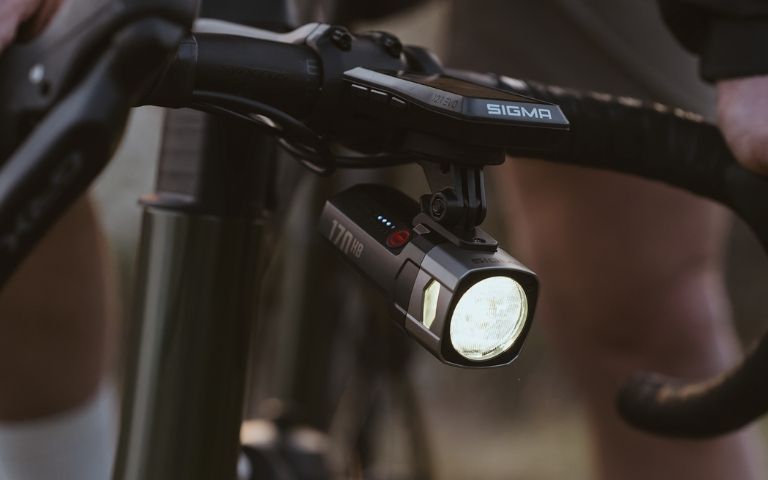
SIGMA has renewed its range of bicycle lights with the new SMART LIGHT SERIES, a family that combines easy-to-use models with others that incorporate LINK connectivity, integration with the SIGMA RIDE application and control from the handlebars.
The new range, recently presented in Girona during Sea Otter Europe, incorporates new BUSTER and NYTE models and completes the AURA generation launched at the end of August.
One of the main new features is the integration of lighting within the SIGMA ecosystem. LINK -compatible products can connect front and rear lights to function as a coordinated system, while the app allows users, depending on the model, to configure lighting modes, check battery status, or install firmware updates.
Two ranges: CORE and LINK
SIGMA has divided the SMART LIGHT SERIES into two families. The CORE SERIES is geared towards simpler lighting, while the LINK SERIES incorporates connectivity features.

LINK-compatible front and rear lights can be paired with each other and, with the exception of the AURA 100 LINK, models in this family can also connect to the SIGMA RIDE app.
The brand also offers compatible controls to operate certain lights directly from the handlebars, without needing to activate the headlight itself while riding.
BUSTER 1700 LINK, the most powerful model of the new generation
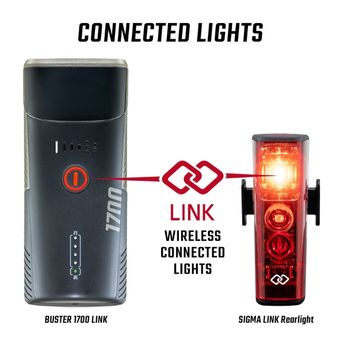
Among the main new features is the BUSTER 1700 LINK , which is positioned at the top of the new BUSTER generation.
According to data provided by SIGMA, it achieves a maximum output of 1.700 lumens and a beam range of up to 210 meters . It features LINK connectivity, integration with SIGMA RIDE, and the REMOTE ONE controller, included with this model, for controlling the different modes from the handlebars.
It also represents a new step within a family that TN already analyzed with the 1600 lumen SIGMA BUSTER 1.600.
Below that is the BUSTER 900 LINK , with up to 900 lumens and a claimed beam distance of 180 meters. It also features LINK and SIGMA RIDE connectivity, although in this case the REMOTE ONE is sold separately.
The most compact option is the BUSTER 160 , with up to 160 lumens and a claimed beam distance of 75 meters. It features five lighting modes, five preset profiles, and a MODE MEMORY function to recall the last used setting. SIGMA claims a maximum runtime of up to 24 hours, depending on the operating mode.
NYTE 50 LINK adds brake light and connectivity
The renewal also affects the rear lighting with the new NYTE 30, NYTE 50 and NYTE 50 LINK.
The NYTE 50 LINK is the connected model in this new family. It can be paired with compatible LINK headlights and SIGMA RIDE, and also features a brake light and emergency stop signal.
The NYTE 50 retains the braking functions but does without LINK connectivity, while the NYTE 30 offers five lighting modes, including three flashing modes, and a maximum advertised battery life of up to 28 hours.
These functions continue a line that SIGMA had already taken to other products such as the NYTE 70 with brake detection and emergency braking , presented at the beginning of 2026.
Main models and prices
The recommended retail prices communicated by SIGMA for the main models of the new range are as follows:
| Córdoba | Main Feature | PVP |
|---|---|---|
| AURA 170 HB LINK | LINK and HIGH BEAM function | 169,95 € |
| AURA 120 LINK | LINK and SIGMA RIDE connectivity | 119,95 € |
| BUSTER 1700 LINK | 1.700 lumens / up to 210 m | 169,95 € |
| BUSTER 900 LINK | 900 lumens / up to 180 m | 74,95 € |
| BUSTER 160 | 160 lumens / up to 75 m | 34,95 € |
| NYTE 30 | Five lighting modes | 24,95 € |
| NYTE 50 | Brake light and emergency braking | 34,95 € |
| NYTE 50 LINK | Braking, LINK and SIGMA RIDE | 42,95 € |
Availability of the new SMART LIGHT SERIES
The new BUSTER and NYTE are available from September 30, 2026 , while the AURA 170 HB LINK, AURA 120 LINK, AURA 90 and AURA 70 arrived on the market on August 26.
SIGMA also offers different combinations of front and rear lights. Several of these packs have been available since September 30, while others will be added gradually throughout October and November.
The new generation showcases an evolution in bicycle lighting towards systems that combine power, connectivity, and visibility-oriented features. Aspects such as effective battery life, actual beam quality, and the usefulness of these features during training would, in any case, require testing under real-world conditions for TN to properly assess them.
