




The fastest running splits in the WTCS: 5km and 10km
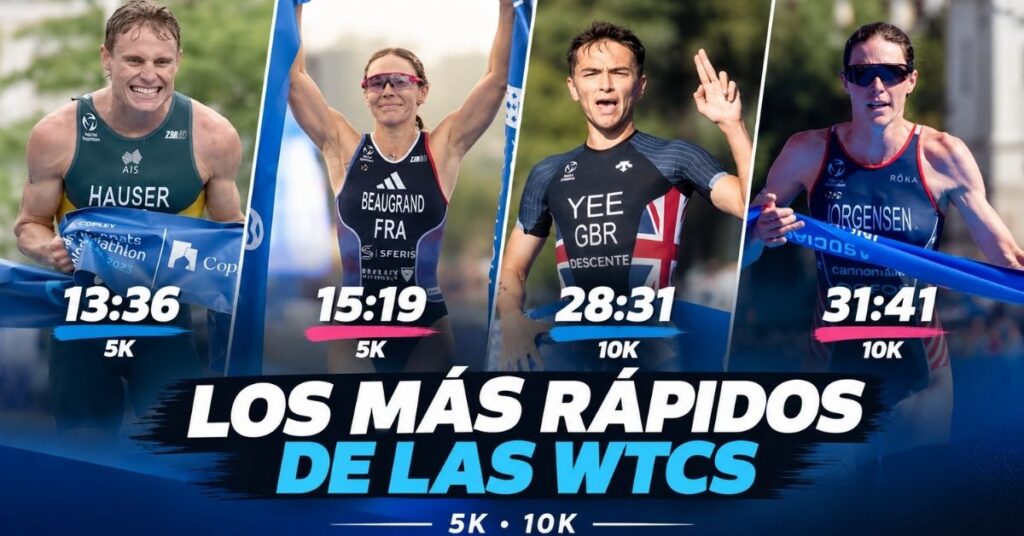
Matthew Hauser's 13:36 and Cassandre Beaugrand's 15:19 in the sprint, along with Alex Yee's 28:31 and Cassandre Beaugrand's 32:12 in the standard distance, top the running split ranking reconstructed by Triathlon News for the WTCS.
The review examines the available results of the World Triathlon Championship Series (WTCS) between 2009 and 2026, including the era of the former ITU WTS. Alongside current benchmarks, the analysis revisits performances that help to understand the history of the circuit, featuring names like Alistair Brownlee , Mario Mola , and especially Javier Gómez Noya.
The Spaniard, one of the great figures in the history of triathlon, left a particularly relevant reference for this analysis: 13:59 in the Stockholm 2012 sprint.
In 2026, World Triathlon inducted Gómez Noya into its Hall of Fame , after a career in which he became the first man to win five elite world titles.

We're talking about the running segment after swimming and cycling , not the total triathlon time or these athletes' track or road race times. The published running split is retained, without adding the second transition (T2).
The 5 km sprint distance and the 10 km standard or Olympic distance are the reference points for reading the tables, but an official split time is not equivalent to a certified athletics mark . Known course variations are indicated in each section.
Data up to October 3, 2026. Ranking compiled by TN from available results, not an official list of World Triathlon records.
You can directly consult the men's sprint , the women's sprint , the men's standard distance , the women's standard distance , the major time barriers , or the Spanish benchmarks.
The tables rank performances, not individual athletes : the same person may appear multiple times. Ties share the same position. "Ranking" refers to the split within this reconstruction, and "Finish" refers to the final position in the triathlon.
The fastest splits in a sprint: the 5km benchmark
Men's 5K: Hauser, Yee and Vilaça
French Riviera 2025 features three of the first four performances: Hauser clocked 13:36 , Yee recorded 13:39 , and Vasco Vilaça finished the segment in 13:40. The data sheet for both elite programs lists a 5.000-meter run.
In contrast, Hamburg 2024 is listed with 4.905 meters . Its times are kept as sprint splits, but should not be read as records over exactly 5.000 meters.
| Order | Athlete | Part Time | Test and year | Meta |
|---|---|---|---|---|
| 1 | Matthew Hauser | 13:36 | French Riviera 2025 | 1 |
| 2 | Alex Yee | 13:39 | French Riviera 2025 | 9 |
| 3 | Matthew Hauser | 13:40 | Hamburg 2024* | 1 |
| 3 | Basque Vilaça | 13:40 | French Riviera 2025 | 2 |
| 5 | Basque Vilaça | 13:49 | Hamburg 2024* | 2 |
| 5 | Manoel Messias | 13:49 | French Riviera 2025 | 14 |
| 7 | Pierre Le Corre | 13:50 | Hamburg 2024* | 3 |
| 7 | Matthew Hauser | 13:50 | Hamburg 2025 | 1 |
| 9 | Alex Yee | 13:52 | London 2026 | 14 |
| 10 | Morgan Pearson | 13:53 | Hamburg 2024* | 23 |
* Hamburg 2024: published race distance of 4.905 m. The table is ordered by segment time, not by pace or times extrapolated to 5 km.
Gómez Noya is a historical figure, even though he no longer appears among these ten performances. In Stockholm 2012, he clocked 13:59 , the fastest split of that race, and finished second behind Jonathan Brownlee. More than a decade later, that time remains among the select group of sub-14-minute performances in the World Series.
Before the acceleration of recent years, Gómez Noya and Mario Mola set that benchmark. Mola ran 13:55 in Hamburg in 2015 and 13:59 in Hamburg in 2018. World Triathlon noted in 2024 that, until then, the 14-minute mark had only been broken three times in the history of the series: twice by Mola and once by Gómez Noya.
Women's 5K: Beaugrand leads and Jorgensen remains among the top contenders
Beaugrand holds three of the top four positions with her times from French Riviera, Hamburg, and London. World Triathlon identified her 15:19 from French Riviera in July 2026 as the fastest women's 5km split in the history of the series.
Among recent times, Jorgensen's 15:31 in Hamburg 2013 continues to stand out . That day she finished sixth: an early indication that running the fastest segment is not always enough to win.
| Order | Athlete | Part Time | Test and year | Meta |
|---|---|---|---|---|
| 1 | Cassandre Beaugrand | 15:19 | French Riviera 2025 | 1 |
| 2 | Cassandre Beaugrand | 15:20 | Hamburg 2024* | 1 |
| 3 | Jeanne Lehair | 15:24 | French Riviera 2025 | 2 |
| 4 | Cassandre Beaugrand | 15:27 | London 2026 | 1 |
| 5 | Leonie Periault | 15:28 | Hamburg 2025 | 1 |
| 6 | Leonie Periault | 15:29 | French Riviera 2025 | 3 |
| 7 | Gwen Jorgensen | 15:31 | Hamburg 2013 | 6 |
| 8 | Beth Potter | 15:32 | Hamburg 2024* | 3 |
| 8 | Jeanne Lehair | 15:32 | Hamburg 2024* | 4 |
| 10 | Beth Potter | 15:35 | Hamburg 2025 | 3 |
* Hamburg 2024: 4.905 m also published in the women's event. This warning applies to that edition; it does not automatically transfer to other years.
The fastest splits in standard distance: the 10km benchmark
Men's 10K: Yee, Wilde and Brownlee in the lead
Yee 's 28:31 and Hayden Wilde's 28:35 in Cagliari 2023 top the list. The official program lists 10.000 meters on foot, but also 38 kilometers of cycling , not 40. It is maintained as a standard category event, without implying that the distance or prior effort was identical to that of other competitions.
The data comes from the official results of Cagliari 2023. The nominal distance on your record does not, in itself, constitute a certified athletic measurement of the running segment.
| Order | Athlete | Part Time | Test and year | Meta |
|---|---|---|---|---|
| 1 | Alex Yee | 28:31 | Cagliari 2023 | 1 |
| 2 | Hayden Wilde | 28:35 | Cagliari 2023 | 2 |
| 3 | Alistair Brownlee | 28:43 | London 2009 | 1 |
| 4 | Alex Yee | 28:46 | Pontevedra 2026 | 3 |
| 5 | Hugo Milner | 28:47 | Torremolinos 2024 | 10 |
| 6 | Alex Yee | 28:50 | Yokohama 2022 | 1 |
| 7 | Steffen Justus | 28:54 | London 2009 | 2 |
| 7 | David cantero | 28:54 | Wollongong 2025 | 2 |
| 9 | Mario Mola | 28:59 | Chicago 2015 | 1 |
| 10 | Sebastian Rank | 29:01 | London 2009 | 4 |
Using the criteria for this reconstruction, nine performances under 29 minutes appear, corresponding to seven athletes . Alex Yee has three; Alistair Brownlee, Hayden Wilde, Hugo Milner, Steffen Justus, David Cantero, and Mario Mola complete that group.
Stockholm 2013 is excluded from the 10K comparison. Although the race was a standard distance event, the course actually run has been documented as approximately 9,6km; for this reason, Javier Gómez Noya's official time of 29:02 is not included in this 10K table.
Brownlee had already recorded 28:43 in London 2009. Therefore, it wouldn't be accurate to describe a progression of records starting with Gómez Noya and continuing with Mola and Yee: a previous performance was already faster. What the table does allow is tracking milestones from different generations of the World Series.
Women's 10K: Beaugrand leads with 32:12
After excluding Stockholm 2013 from the 10K comparison due to the actual walking distance, Cassandre Beaugrand's 32:12 at Weihai 2026 now leads the women's 10K table.
World Triathlon highlighted that split when analyzing the Weihai 2026 race. As in the rest of the article, the table compares published splits from standard distance races, but does not treat them as ratified athletic records.
| Order | Athlete | Part Time | Test and year | Meta |
|---|---|---|---|---|
| 1 | Cassandre Beaugrand | 32:12 | Weihai 2026 | 1 |
| 2 | Gwen Jorgensen | 32:15 | Yokohama 2016 | 1 |
| 3 | Cassandre Beaugrand | 32:16 | Cagliari 2022 | 8 |
| 4 | Beth Potter | 32:17 | Weihai 2026 | 2 |
| 5 | Cassandre Beaugrand | 32:25 | Cagliari 2023 | 4 |
| 6 | Flora Duffy | 32:27 | Abu Dhabi Final 2022 | 1 |
| 7 | Cassandre Beaugrand | 32:35 | Pontevedra 2026 | 1 |
| 8 | Gwen Jorgensen | 32:36 | Yokohama 2015 | 1 |
With Stockholm 2013 out of the comparison, no female sub-32 split appears among the standard distance performances remaining in this reconstruction.
Stockholm 2013 is excluded from the 10K tables because the race course has been documented as approximately 9,6 km. When a significant deviation from the reference distance is known, TN does not use that split to rank the 10K.
How many times have the great barriers of time been broken?
Another way to measure how exceptional these splits are is to look at how many triathletes have managed to overcome certain barriers within the World Series.
Men's standard distance: splits under 29 minutes
| Athlete | Under-29 times | Partial(s) | Evidence) |
|---|---|---|---|
| Alex Yee | 3 | 28:31 28:46 28:50 |
Cagliari 2023 Pontevedra 2026 Yokohama 2022 |
| Alistair Brownlee | 1 | 28:43 | London 2009 |
| Hayden Wilde | 1 | 28:35 | Cagliari 2023 |
| Hugo Milner | 1 | 28:47 | Torremolinos 2024 |
| Steffen Justus | 1 | 28:54 | London 2009 |
| David cantero | 1 | 28:54 | Wollongong 2025 |
| Mario Mola | 1 | 28:59 | Chicago 2015 |
Women's Standard Distance: No sub-32 performances in reconstruction
After excluding Stockholm 2013 due to the actual distance of its walking course, there are no female performances below 32 minutes in the standard distance comparison reviewed by TN.
Men's sprint: splits under 14 minutes
| Athlete | Under-14 times | Partial(s) | Evidence) |
|---|---|---|---|
| Matthew Hauser | 3 | 13:36 13:40 13:50 |
French Riviera 2025 Hamburg 2024* Hamburg 2025 |
| Basque Vilaça | 3 | 13:40 13:49 13:57 |
French Riviera 2025 Hamburg 2024* Hamburg 2025 |
| Alex Yee | 2 | 13:39 13:52 |
French Riviera 2025 London 2026 |
| Mario Mola | 2 | 13:55 13:59 |
Hamburg 2015 Hamburg 2018 |
| Manoel Messias | 1 | 13:49 | French Riviera 2025 |
| Pierre Le Corre | 1 | 13:50 | Hamburg 2024* |
| Morgan Pearson | 1 | 13:53 | Hamburg 2024* |
| Javier Gómez Noya | 1 | 13:59 | Stockholm 2012 |
| Jelle Geens | 1 | 13:58 | Hamburg 2024* |
| John Reed | 1 | 13:58 | French Riviera 2025 |
| Casper Stornes | 1 | 13:59 | Hamburg 2024* |
| Hayden Wilde | 1 | 13:59 | French Riviera 2025 |
Women's sprint: splits under 16 minutes
The WTCS corpus reviewed by TN shows 45 female performances under 16 minutes, achieved by 19 triathletes . Cassandre Beaugrand and Gwen Jorgensen lead the count with six each, while Tilda Månsson has five.
| Athlete | Under-16 times | Partial(s) | Evidence) |
|---|---|---|---|
| Cassandre Beaugrand | 6 | 15:19 15:20 15:27 15:37 15:48 15:51 |
French Riviera 2025 Hamburg 2024* London 2026 Hamburg 2025 Hamburg 2018 Quiberon 2026 |
| Gwen Jorgensen | 6 | 15:31 15:44 15:45 15:46 15:50 15:57 |
Hamburg 2013 Hamburg 2016 Hamburg 2015 Hamburg 2014 Hamburg 2024* Abu Dhabi 2015 |
| Tilda Mansson | 5 | 15:42 15:45 15:49 15:51 15:58 |
London 2026 Hamburg 2025 Quiberon 2026 French Riviera 2025 Hamburg 2026 |
| Jeanne Lehair | 4 | 15:24 15:32 15:53 15:56 |
French Riviera 2025 Hamburg 2024* Hamburg 2025 London 2026 |
| Leonie Periault | 4 | 15:28 15:29 15:45 15:56 |
Hamburg 2025 French Riviera 2025 London 2026 Hamburg 2026 |
| Beth Potter | 4 | 15:32 15:35 15:45 15:45 |
Hamburg 2024* Hamburg 2025 French Riviera 2025 London 2026 |
| Lisa Tertsch | 2 | 15:36 15:36 |
Hamburg 2024* London 2026 |
| Emma lombi | 2 | 15:39 15:39 |
Hamburg 2024* French Riviera 2025 |
| Kate Waugh | 2 | 15:48 15:57 |
Hamburg 2024* Hamburg 2025 |
| jolien vermeylen | 1 | 15:44 | Hamburg 2025 |
| Nina Eim | 1 | 15:44 | French Riviera 2025 |
| Taylor Spivey | 1 | 15:47 | French Riviera 2025 |
| Annika Koch | 1 | 15:48 | Hamburg 2024* |
| Erin Densham | 1 | 15:50 | Hamburg 2012 |
| Georgia Taylor-Brown | 1 | 15:53 | London 2026 |
| Tanja Neubert | 1 | 15:54 | French Riviera 2025 |
| Emma Jackson | 1 | 15:55 | Hamburg 2014 |
| Vicky Holland | 1 | 15:57 | Hamburg 2015 |
| Anna Godoy | 1 | 15:59 | French Riviera 2025 |
* Hamburg 2024 is listed with a published race distance of 4.905 meters. These times are counted as splits of a WTCS sprint event, but should not be interpreted as times achieved over exactly 5.000 meters.
Javier Gómez Noya, Mario Mola and David Cantero: three Spanish generations
The Spanish presence in this analysis doesn't begin with the most recent records. Gómez Noya already ran 13:59 in Stockholm 2012 , the best split of that sprint race. His 29:02 from Stockholm 2013 remains the official split of that event, but it's excluded from the 10km comparison due to the actual distance of the course.
These two achievements help explain the sporting dimension of a career that goes far beyond these records. World Triathlon inducted Gómez Noya into its Hall of Fame in 2026 and notes that he was the first man to win five elite world titles . He also won the Olympic silver medal in London 2012.
The fact that Gómez Noya doesn't currently top the overall split rankings doesn't diminish his historical importance. His 13:59 sprint time remains one of the great benchmarks of the World Series from that era.
Then came Mario Mola. The Mallorcan dropped to 13:55 in Hamburg 2015 and repeated a sub-14 time with 13:59 in Hamburg 2018. In the standard distance, his 28:59 in Chicago 2015 remains within the sub-29 performance group of the rebuilding era.
TN's archives already included Mola's three U14 ITU races in 2018. In addition to the two Hamburg performances, they also included Mooloolaba 2014, which is excluded from this ranking because it was a World Cup event, not a World Series race.
The current generation includes David Cantero , whose 28:54 in Wollongong 2025 places him among the fastest splits recorded in this analysis. This time accompanied his second-place finish in the Wollongong Grand Final.
Gómez Noya, Mola, and Cantero thus represent three different eras of elite Spanish triathlon : 13:59 in the sprint for Noya, 13:55 and 28:59 for Mola, and 28:54 for Cantero . These are WTCS/WTS circuit times, not officially recognized national athletics records.
Why the fastest split doesn't always bring victory
Yee appears very high in the sprint rankings with 13:52 in London 2026, but finished 14th . Mola ran 13:55 in Hamburg 2015 and finished third. Gómez Noya, for his part, recorded the best split in Stockholm 2012 with 13:59 and finished second.
Race time only measures the last segment; it does not eliminate the disadvantage accumulated before starting to run.
The opposite case is that of Mola in Chicago 2015. TN's reconstruction, based on the official splits, places him 17th among the finishers as he exited the second transition, 39 seconds behind the leader . His 28:59 run allowed him to ultimately win. The position and the gap at that point are TN's calculations; the split and the victory are recorded in the Chicago 2015 results.
In the Pontevedra 2026 Final, Yee clocked 28:46 and finished third. He had started the race approximately 50 seconds behind Hauser and finished four seconds behind the winner. His split brought him closer to victory, but it didn't make up for the entire deficit.
Are these official 5km and 10km records?
The times shown are officially published split times; this ranking is compiled by TN. It should not be confused with a list of officially recognized 5km or 10km athletics records. Total times for sprint or Olympic triathlons are also not compared.
A program's listing of 5.000 or 10.000 meters indicates its nominal distance , but does not in itself certify a specific measurement. Hamburg 2024 presents a different situation: the program's own data sheet lists a shorter distance, 4.905 meters, which must be used when interpreting the split time.
In addition to distance, factors such as elevation gain, curves, surface, conditions, and prior effort in swimming and cycling are taken into account. A ranking in these tables doesn't determine who the best triathlete is, nor does it attribute the difference solely to shoes or training without further analysis.
What pace do the WTCS triathletes run at?
Regarding the 5.000 meters published for French Riviera 2025, TN calculates approximately 2:43 min/km for Hauser's 13:36 and 3:04 min/km for Beaugrand's 15:19 . This is obtained by dividing the split time by the distance listed on their profile.
At a standard distance, Yee's 28:31 equates to approximately 2:51 min/km over the nominal 10.000 meters of Cagliari 2023. This equivalence is calculated using the published data, not proof that the course was exactly 10 km long. Pace calculations have not been performed on older programs without recovered numerical distance data.
The difference is evident in Hamburg: Hauser's 13:40 in 2024 is roughly equivalent to 2:47 min/km over 4.905 meters . Dividing that by five kilometers would give 2:44 min/km, attributing a pace to that split that doesn't match his stats. These equivalencies describe specific performances, not the typical pace of all professional triathletes.
How was this historical ranking of WTCS splits compiled?
The source for this sporting event is World Triathlon . TN has reviewed the fastest times per race and checked the detailed results that could be included in the tables; not every row for every participant in the period has been downloaded.
The initial inventory included 151 entries between 2009 and 2026. Eight corresponded exclusively to relays, and nine did not return results. The remaining 134 events included 268 elite men's and women's main programs. The absence of results has not been interpreted as cancellation.
After excluding Kitzbühel 2013, Montreal 2021, Montreal 2022, and Hamburg 2023 due to their special formats, 130 events and 260 candidate programs remained , covering either sprint or conventional standard distances. For the 10 km comparisons, Stockholm 2013 is also excluded because a running course of approximately 9,6 km was documented.
Only athletes with a valid final ranking and a completed split are included. Athletes who dropped out, did not show up, were lapped, or were disqualified are excluded, as are relays, supersprints, junior and U23 categories, age groups, World Cups, Olympic Games , test events, and track and field races. Published times are retained, without penalty reductions or extrapolating them to other distances.
The result is a reconstruction of the fastest splits found in the available results . The nine innings without results and the missing distances in some of the historical data limit its scope.
